
Agentic AI Starts with the Right Context
Agentic AI is only as effective as the quality of the data and context it receives. Providing the right information at the right time minimizes token consumption and reducing the risk of hallucinations.
Mindbreeze InSpire performs a semantic pipeline, relevance model, RAG, and fact extraction before any data reaches the LLM (Context Engineering). AI Agents work with a small set of highly relevant, pre-verified facts — not with all the noise around.
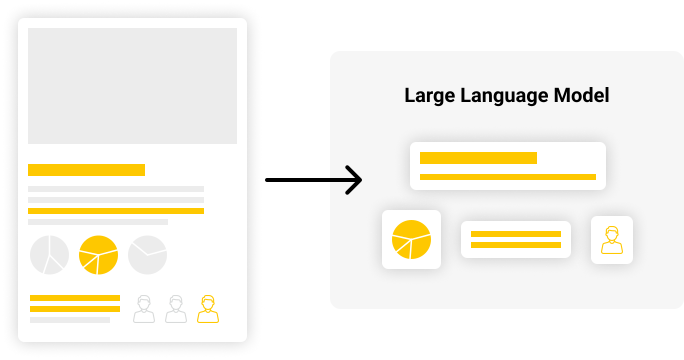
Efficiency & Cost Control through Relevance-First AI

Lower token consumption & cost

Faster response times

Higher accuracy

Scalability

Model flexibility
AI Agents work behind Mindbreeze Insight Touchpoints
How AI Agents Get Things Done

Tools
AI agents are connected to enterprise data sources, APIs, and business systems, enabling them to do far more than generate text. They gather information, trigger workflows, and support real business processes. Based on the context, they dynamically select the right tools to complete each task.

Memory
Agents track what has already happened and capture the essence of each interaction. When faced with a new challenge, the system draws on these meaningful memories to guide its response.

Planning
An AI agent breaks large goals into smaller, manageable steps — and determines what needs to happen next, without waiting for human guidance.
Autonomous task execution
AI Agents carry out multi-step tasks (research, comparison, drafting, summarization) without manual hand-offs between tools.
Cross-system orchestration
Instead of switching between CRM, ERP, intranet, and file shares, the AI agents work across all connected systems from a single point of entry.
Governed & auditable AI
Every agent action is traceable, permission-aware, and based on verified enterprise data. This ensures secure AI use, even in industries with strict compliance requirements.
Knowledge-grounded reasoning
AI Agents reason over your organization's actual knowledge graph and documents, not generic web data, reducing the risk of hallucination and increasing trust.
Employees focus on the goal. Mindbreeze transforms AI from simple assistance into goal-oriented execution by coordinating the right agents, tools, and enterprise data sources automatically.
Multi-Agent Systems
A multi-agent system brings together specialized AI agents that collaborate on different parts of a task. For example, one agent may retrieve relevant information, another may analyze or compare content, another may check context and permissions, and another may trigger a workflow or prepare the next action.
This helps transform AI from simple assistance into goal-oriented execution. Employees can start with a natural-language request, while Mindbreeze InSpire coordinates the right agents, tools, and enterprise data sources in the background.
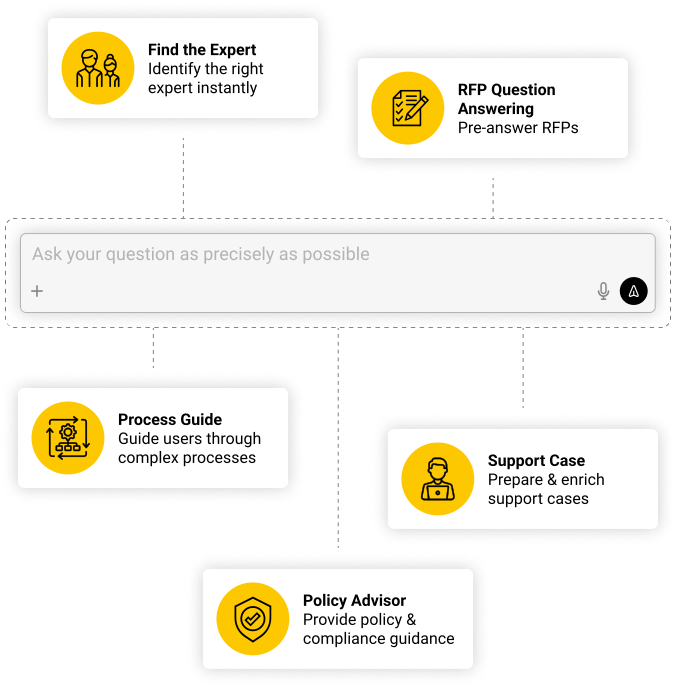
Knowledge Graph
By creating a connected view of enterprise knowledge, Mindbreeze InSpire identifies relationships between people, documents, systems, and topics across the organization. This makes information easier to understand, explore, and use in context. By linking relevant data points, teams can uncover insights faster and receive answers that reflect the full picture of their enterprise knowledge.
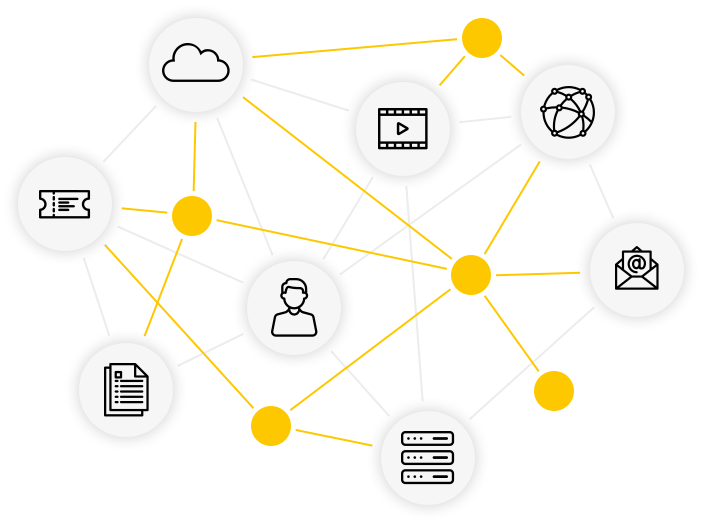
RAG and Agentic RAG
Retrieval Augmented Generation helps provide accurate, grounded answers based on trusted enterprise data. With Agentic RAG, Mindbreeze InSpire goes beyond simple responses by reasoning across information, retrieving the right content, and supporting users in completing complex tasks. This enables employees to work more efficiently while ensuring results remain connected to reliable company knowledge.
Frequently asked questions
Large Language Models (LLMs) are models in the field of AI. LLMs are trained with a large amount of content to “understand” natural language and generate human-like output and dialog.
Foundation models are large machine learning models in the field of generative AI that are trained with a variety of data and optimized for a wide range of applications.
Large Language Models (LLMs), such as GPT, should be used where they are really effective. For example, LLMs generate texts, provide additional ideas for brainstorming, translate and create summaries. These tools provide a certain level of added convenience and, when used correctly, make tasks at work much easier.
Prompt engineering is the process of designing instructions given to Large Language Models (LLMs) to get the most valuable output. Proper prompts guide the LLM towards producing accurate, relevant, and contextually appropriate answers. Prompt engineering is crucial for the improvement of LLM performance.
RAG, or retrieval-augmented generation, is a method that enhances the quality of generated texts of Large Language Models. With this method, relevant information is accessed from a database or a set of documents, and then text-based information is generated based on this retrieved information.
In data hallucination, Large Language Models generate incorrect answers that appear plausible due to coherent and fluent texts. These generated answers may lack completeness, contain outdated information, or even include false statements, potentially leading companies astray and prompting incorrect and erroneous decision-making.
To minimize data hallucination, a company can combine company knowledge extracted by an insight engine with the broader linguistic comprehension of a Large Language Model (LLM). This integration allows for a more detailed analysis, ensuring that generated outputs are not only linguistically coherent but also grounded in accurate and relevant company-specific information. Moreover, Mindbreeze will provide the factual basis for the answer, so that any answer can be validated easily.
Knowledge graphs are representations of knowledge within a company or other entity that is presented in a graph. Users can see how information is organized and connected from various sources, providing a comprehensive view of how different topics are related. The rich semantics help especially with information retrieval to understand intent and learn how entities are related, enabling meaning-based computing.
Vector search is a technique used in information retrieval to find items that are semantically similar to a given query item. In contrast to conventional keyword-based search systems that only match exact words or phrases, vector search considers the semantic meaning and context of the search query. With any vector search, the quality and context of the vector are crucial for high-quality results, therefore compelling semantic pipelines are highly relevant in such a context to analyze and prepare the information accurately.
Natural Language Processing (NLP) focuses on the interaction between computers and humans through natural language. It enables software to understand and analyze human language as well as respond and generate human-like texts – for example, in chatbots or large language models (LLMs).
An AI model as a service is a cloud-based service that provides access to pre-trained artificial intelligence (AI) models. Mindbreeze uses these AI models to generate answers from internal company data in a safe and secure way.
Mindbreeze transforms traditional search into an intelligent discovery engine powered by AI:
- Perform multimodal searches across text, images, audio, video, and even voice queries with speech-to-text capabilities.
- Unlock deeper insights with semantic search driven by advanced vector embeddings that understand intent and context, not just keywords.
- Combine lexical precision with semantic intelligence through hybrid search for unmatched accuracy.
- Let the system auto-refine queries and re-rank results using neural models and AI-driven relevance tuning.
- Enjoy personalized results that evolve with every interaction, using behavioral analytics for smarter recommendations.
- Enrich your data with entity extraction, sentiment analysis, intent classification, and graph-based search to uncover relationships and hidden patterns.
- Explore results visually with guided navigation, geocoding for location context, and advanced filtering tools.
This means faster answers, deeper insights, and a truly personalized search journey—perfect for enterprise teams and data-driven decision-makers.
Mindbreeze supports a structured development lifecycle with specialized roles:
- Connector Developers: Build and maintain custom connectors for proprietary data sources.
- Ingestion & Content Processing Engineers: Manage data ingestion, semantic processing, enrichment, and indexing.
- Relevance & Search Experience Admins: Fine-tune ranking models, query pipelines, and result relevance.
- Insight App Builders: Assemble search-driven applications using low-code tools.
- Insight App Developers: Extend capabilities with custom code or advanced integrations.
We provide a full development and monitoring toolkit:
- SDKs and OpenAPI Documentation for seamless integration in multiple programming languages.
- App.telemetry, a built-in distributed observability system, offering detailed metrics and task tracing.
- Administration Tools for debugging ingestion, semantic chunking, embeddings, and indexing pipelines.
- Evaluation Framework to score, validate, and auto-tune relevance and AI-driven search features.
The Evaluation Framework empowers teams to run reproducible experiments and diagnostics:
- Use synthetic and curated test datasets to validate indexing and retrieval pipelines.
- Evaluate GenAI performance and relevance tuning with auto-scoring.
- Monitor results through dashboards and analytics for data-driven improvements.
This ensures the system continuously evolves and maintains high accuracy at scale.
User behavior is a core input to optimize Mindbreeze:
- Mindbreeze captures implicit (usage) and explicit (ratings, feedback) signals.
- Feedback is integrated into the Evaluation Framework to expand datasets and improve personalization.
- User profiles and interaction analytics help refine ranking models and surface more relevant results over time.
This creates a self-improving search ecosystem that adapts to user needs dynamically.
The Mindbreeze InSpire Relevance Model helps deliver more accurate and context-aware answers by learning from previous searches and user interactions. Combined with Retrieval Augmented Generation, it grounds AI-generated responses in trusted enterprise data.
Yes. Mindbreeze InSpire supports multimodal LLMs that allow organizations to retrieve insights from images, videos, audio, or text.
Mindbreeze InSpire continuously refines search relevance and answer quality by learning from previous human interactions. Over time, it adapts to your organization's information needs while ensuring that employees' queries and behavior remain private. User interactions are neither transmitted to nor evaluated by third-party providers, enabling continuous improvement without compromising data protection or organizational control.